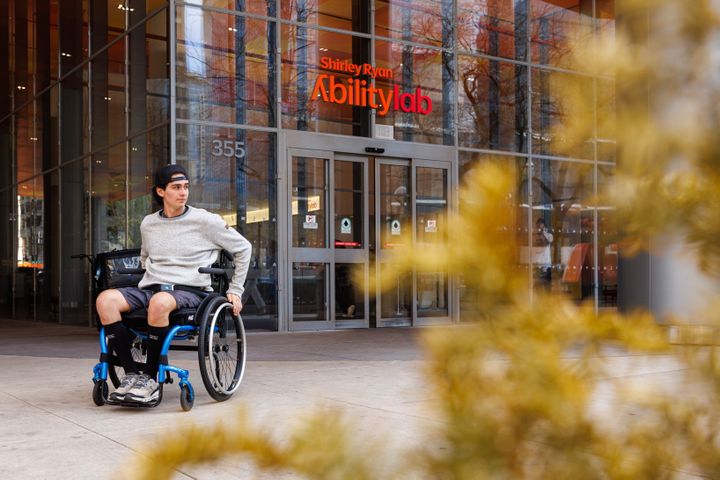
Researchers in the U.S. are currently investigating a compound that could mark a breakthrough – and bring new hope to millions of people.
Wheelchairs hum softly while traversing the floor. Walking aids clatter as muffled voices fill the light-flooded rooms. The Shirley Ryan Ability Lab in Chicago is a source of hope. Here, Dr. Monica Perez and her team are testing a compound that could make the impossible possible: to stimulate nerve cells to regenerate after spinal cord injury. The name of this new hope is NVG-291. Its effect has the potential to change lives.
“Our field of research has already witnessed many clinical studies. However, this approach, which aims to regenerate neurones and promote their growth, is something quite unique,” the study principal investigator explains.

Overcoming the Blockade
The spinal cord resembles an information highway on which signals travel back and forth between the brain and the body. In the event of an injury, this route is blocked, and nerves cannot re-establish connections. Scar tissue that forms at the site of the injury prevents the nerve fibres from regenerating. Some approaches focus on breaking down the growth-inhibiting substances in this scar tissue. Yet Dr. Monica Perez and the company NervGen Pharma Corp are pursuing a different approach. Instead of attacking the inhibitors directly, they target their docking site, the so-called sigma receptor, which serves as a kind of control centre within the scar tissue.

This is where NVG-291 comes into play. This novel substance is injected subcutaneously. It is designed to render the scar tissue permeable and stimulate damaged nerves to regenerate and form new connections. The special feature: NVG-291 addresses the cause of the damage, not merely the symptoms.
Research into this approach dates back to the 1990s to the laboratory of US neuroscientist Prof Jerry Silver. He was the first to describe how scar tissue covering the injury site prevents nerves from regrowing – an insight that changed our understanding of spinal cord injuries forever. Dr. Monica Perez has made it her mission to translate this groundbreaking discovery into an effective treatment. “I draw inspiration from my patients. We still have no cure, no approved treatment. Our NervGen study aims to close this gap,” says the Chilean-born researcher, who has been working in spinal cord research for more than 20 years.

Back to Life
So, what does this research imply for people whose lives have been upended by a spinal cord injury? One of them is Niko Paskos, a participant in the NervGen trial. For him, the success of the compound could change literally everything.
The 20-year-old American had just returned from an exchange semester in Hawaii when his life took a dramatic turn.
“I remember feeling like anything was possible. I was ready to conquer the world, went surfing or running every day, and enjoyed being physically active,” Niko muses.
Until the accident happened.
He was traveling with friends on a rainy evening: “I was in the back seat when we veered off the road and smashed into a telephone pole.” Niko regained consciousness four days later. The diagnosis: a severe concussion, numerous broken bones, and an incomplete spinal cord injury at level C7, in the lower portion of the cervical spine. “I was hooked up to a ventilator and unable to speak. I just lay there while the doctors explained my condition. No manual tells you how to deal with news like that.”
Niko had no idea what to expect next. The doctors reckoned he might never be able to walk again. “The first few weeks after my injury were particularly tough,” the Texan recalls. Niko needed help with everything – to get out of bed, take a shower, or use the toilet. He spent a great deal of time in rehabilitation in the vague hope that some bodily functions would return.
“Given my injury level, my hands and fingers are affected in particular.” Little tasks such as closing a zip, turning a doorknob, or pulling a wallet out of his trousers are incredibly difficult for Niko. NVG-291 is designed specifically for people like him. “We screen patients suffering from cervical spinal cord injuries, meaning that both arms and legs are affected. These individuals struggle with reaching for things – but their legs, and therefore their mobility, are also impaired,” explains Dr. Perez.

Despite such challenges, Niko remains optimistic:
“I feel incredibly privileged to be part of this ground-breaking research and cannot wait to see where it leads. Deep down, I truly believe that this treatment will change the lives of millions of people.”
When Research Instills Hope
The journey from initial laboratory research to the clinical trial, with the first patient enrolled in 2023, has been a lengthy one. Even though the results are preliminary and further research is required, the early signs of improved hand function are impressive. Progress has been made even in patients whose injury was sustained years ago. This proves that functional improvements are possible even long after an injury.
If successful, this would not only represent a medical breakthrough for many affected patients, but could be a real glimmer of hope for a new life without restrictions.
As Niko Paskos himself explains:
“If this study is successful and I can walk again, the very first thing I will do is run to the airport and hop on a plane to Hawaii. That is my plan. Who needs a car then? I would walk to the beach, run along the beach. I think I would never stop running.”
How Wings for Life supports:
Wings for Life has actively supported the NervGen study and co-funded it with 2.56 million Euros via the “Accelerated Translational Program”. Thank you for making projects like this possible with your donations and helping to find a cure for spinal cord injury.